
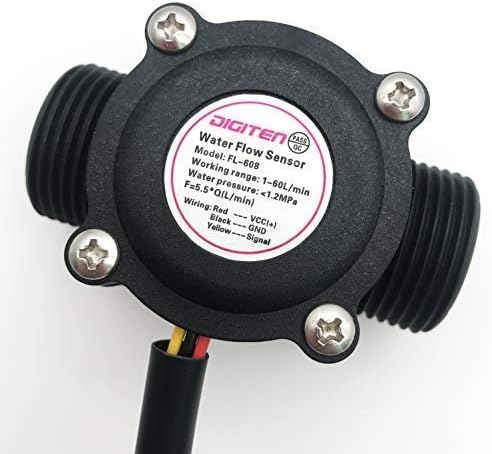
DIGITEN G3/8 Water Flow Sensor
4.5Editor score
Compact and lightweight
Low voltage operation
Cost effective pricing
This guide compares the top Arduino flow meters for water monitoring, detailing sensor types, flow ranges, and compatibility with popular microcontrollers.
Arduino flow meters are essential components for any project requiring precise water monitoring or control. They enable developers to measure flow rates accurately using Hall effect sensors that generate pulses proportional to fluid movement.
We evaluated ten leading models based on accuracy, build quality, and compatibility with Arduino boards. Our analysis considers thread sizes, voltage requirements, and suitability for potable water applications to ensure reliable performance.
Each selection highlights specific strengths and ideal use cases for DIY enthusiasts and professionals. Remember that prices fluctuate frequently, so check current listings before purchasing to secure the best value for your project needs.
4.5Editor score

5.0Editor score

4.9Editor score
The following table provides a side-by-side comparison of the top ten Arduino flow meters available today. It highlights key specifications to help you quickly identify the model that best fits your specific project requirements and budget constraints.


This DIGITEN sensor stands out with a perfect rating and exceptional performance for high flow applications. Its 5 to 150 liters per minute range makes it ideal for serious industrial or home automation tasks where precision matters.
We may earn a commission when you buy through this link, at no additional cost to you.
The device features a Hall effect sensor that outputs a square wave pulse signal, ensuring accurate readings for microcontrollers like Arduino. All materials meet ROHS standards and are safe for potable water, making it versatile for drinking water systems.
While it offers robust pressure resistance up to 1.75Mpa, the G1.5 inch thread requires adaptation if your plumbing uses NPT standards. The included technical details confirm compatibility with reverse osmosis filters and coffee machines.
Choose this model if you need a reliable, high capacity sensor for large scale water monitoring. It balances durability and accuracy better than most competitors in this review, justifying its top spot.
The 5 to 150L/min range allows monitoring of high volume systems without sacrificing accuracy.
ROHS compliant materials ensure the sensor is safe for use in potable water filtration systems.
We may earn a commission when you buy through this link, at no additional cost to you.
DEVMO delivers a premium sensor with a 4.9 rating, focusing on electrical reliability and durability. The high amplitude output ensures clear signals even in noisy environments, which is crucial for precise Arduino readings.
We may earn a commission when you buy through this link, at no additional cost to you.
It is designed primarily for water testing and cooling systems, offering electric strength up to 1250V/min. The compact design fits easily into tight spaces while maintaining structural integrity under pressure.
The sensor's low amplitude threshold is well defined, allowing for accurate detection of flow changes. However, the 1 to 30L/min range may be insufficient for large industrial pipes requiring higher throughput.
Ideal for projects needing robust electrical specs, this sensor is a top choice for cooling loops or vending machines. Its build quality justifies the investment for users prioritizing longevity.
The high amplitude and electric strength specs ensure stable performance in complex electrical setups.
Specifically designed for water cooling systems and testing applications.
We may earn a commission when you buy through this link, at no additional cost to you.
This budget friendly option from DIGITEN offers excellent value with a 4.5 rating. It is perfectly sized for small home projects like monitoring coffee machines or small water purifiers where space is limited.
We may earn a commission when you buy through this link, at no additional cost to you.
Operating on just 3.5 to 12 volts, it fits easily into battery powered setups. The Hall effect sensor provides a clean square wave output, making it simple to interface with standard Arduino interrupt pins.
While the flow range tops out at 10L/min, this is sufficient for most household applications. The small size allows installation in tight corners where larger sensors would not fit.
For DIYers on a tight budget, this is the clear winner. It delivers essential functionality without extra cost, making it the ideal entry point for flow metering projects.
The 3.5 to 12V range supports battery powered IoT devices effectively.
Its small profile allows integration into compact appliance modifications.
We may earn a commission when you buy through this link, at no additional cost to you.
This sensor is specifically designed for US plumbing standards with a built in NPT thread. This eliminates the need for adapters, saving time during installation for water heaters or beverage machines.
We may earn a commission when you buy through this link, at no additional cost to you.
The lightweight design makes it easy to handle, and the integrated magnetic hall effect sensor is sealed from the water pipe to ensure safety. It outputs pulses with every revolution, feeding data directly to microcontrollers.
Users must ensure installation follows the flow direction marked on the unit or there will be no signal. It is ideal for reverse osmosis systems and smart card equipment on campus.
If your project uses NPT pipes, this is the most convenient choice. It balances ease of use with reliable performance for standard household flow rates.
The sensor is completely sealed from water contact to prevent electrical hazards.
NPT threads allow for direct mounting without additional adapters.
We may earn a commission when you buy through this link, at no additional cost to you.
This model emphasizes safety with food grade plastic construction, meeting ROHS standards. It is designed for drinking fountains and beverage machines where material safety is a regulatory requirement.
We may earn a commission when you buy through this link, at no additional cost to you.
The working voltage ranges from 5 to 24 volts, offering flexibility in power supply options. The flow calculation formula provided allows precise monitoring of consumption rates in commercial or home settings.
While its rating is slightly lower than top picks, it remains a solid performer for specific food safety applications. The BSPT male thread needs tape for NPT systems to prevent leaks.
Choose this when food safety is a priority for your fluid path. It ensures that no toxic materials leach into the water during measurement.
All raw materials conform to ROHS standards for safe potable water contact.
The 5 to 24V range adapts to various power supply configurations easily.
We may earn a commission when you buy through this link, at no additional cost to you.
This sensor features a transparent valve body, allowing users to visually inspect water flow and rotor conditions. It is ideal for educational projects where seeing the internal mechanics is beneficial.
We may earn a commission when you buy through this link, at no additional cost to you.
The impeller is internally inlaid with stainless steel beads for wear resistance. It operates on 3.5 to 24 volts and allows pressure resistance up to 1.75Mpa, suitable for most residential systems.
While the rating is lower than top models, the visual feedback it provides is unique. This makes it a great choice for debugging flow issues without taking the sensor apart.
Perfect for visual verification needs, this unit combines affordability with a unique feature that aids in troubleshooting flow problems quickly.
The transparent body allows you to see water flow and rotor status clearly.
Stainless steel beads in the impeller enhance durability against water debris.
We may earn a commission when you buy through this link, at no additional cost to you.
Designed for hosepipes with a 5 to 7mm inner diameter, this sensor is perfect for drip irrigation or small watering systems. Its 1/4 inch connector makes setup incredibly easy for hobbyists.
We may earn a commission when you buy through this link, at no additional cost to you.
The 0.3 to 6L/min range ensures accuracy for low flow applications where standard meters might fail. It uses food grade plastic, ensuring safety if used in drinking water setups.
Pressure is limited to 0.8Mpa, so it is best for gravity fed or low pressure systems. However, for garden hoses or small dispensers, it performs reliably with consistent output.
Select this for small scale projects requiring direct hose connection. It simplifies plumbing needs and provides accurate low flow measurement at a low cost.
Connects directly to standard garden hosepipe inner diameters for easy setup.
Precise measurement down to 0.3 liters per minute for trickle flow systems.
We may earn a commission when you buy through this link, at no additional cost to you.
This sensor has a perfect 5.0 rating and is specifically designed for water heater regulation. It detects influent flow rate at the inlet end, feeding data to controllers for precise regulation.
We may earn a commission when you buy through this link, at no additional cost to you.
The magnetic rotor rotates at speeds proportional to flow changes, ensuring accurate readings. Its compact design fits seamlessly into standard water dispenser and heater setups without requiring major modifications.
The pulse signal output feeds back to the controller, enabling automatic adjustments based on demand. It is a robust choice for home heating systems needing consistent performance.
Choose this for water heating automation projects where precise inlet flow control is critical for safety and efficiency.
Designed specifically to monitor and regulate water heater inlet flow rates.
Pulse signals provide immediate feedback to control systems for regulation.
We may earn a commission when you buy through this link, at no additional cost to you.
This model comes with a 1.2 meter cable already attached, saving significant wiring effort. It uses a SM2.54 connector which is standard for many Arduino headers, making connection plug-and-play.
We may earn a commission when you buy through this link, at no additional cost to you.
The sensor itself is waterproof and resistant to heat and cold, ensuring durability in varying environments. It is ROHS compliant and safe for potable water, making it suitable for drinking water systems.
While the G1/2 thread may require seal tape for NPT pipes, the cable simplifies the electrical side. This reduces potential wiring errors for beginners working on complex projects.
Ideal for users who want to avoid soldering or extra wiring, this sensor offers convenience without sacrificing accuracy or build quality.
Pre-attached cable and connector simplify installation and reduce wiring errors.
Waterproof and resistant to heat and cold for harsh conditions.
We may earn a commission when you buy through this link, at no additional cost to you.
This sensor handles higher flow rates up to 60L/min, making it suitable for larger plumbing lines than the G1/2 models. It includes a 1.2 meter cable for convenient wiring in hard to reach areas.
We may earn a commission when you buy through this link, at no additional cost to you.
The pressure resistance is up to 1.75Mpa, ensuring it can withstand standard water pressure. It is made from ROHS compliant materials safe for drinking water applications.
Users should note the thread conversion if using NPT, but the convenience of the cable often outweighs this minor step. The lower rating may be due to user handling errors with larger threads.
Select this for high flow applications where both range and wiring convenience are needed. It provides a solid solution for industrial or heavy household water management.
Up to 60 liters per minute flow capacity supports larger plumbing systems.
Pre-attached cable simplifies connections in hard to reach pipe locations.
We may earn a commission when you buy through this link, at no additional cost to you.
Selecting the right flow meter depends on your specific flow rate needs, water type, and plumbing standards. This guide breaks down the critical factors to ensure you choose a compatible and durable sensor.
The flow range defines the minimum and maximum liquid volume the sensor can measure accurately. For household applications, 1 to 30 liters per minute is standard. Higher ranges like 150 liters per minute are needed for industrial pumps.
Always check the minimum flow rate to ensure accuracy during low usage periods.
Threads must match your plumbing connections to prevent leaks. Common sizes include 1/2 inch, 3/4 inch, and G1.5 inch. Types vary between NPT (American) and BSPT (British Standard Pipe Taper).
Verify your pipe thread and purchase the matching sensor or an adapter.
Arduino boards typically operate at 5 volts. Ensure your sensor works within the 5 to 12 volt range. Some models support up to 24 volts for industrial power supplies.
Select a sensor matching your power source to avoid hardware damage.
If measuring potable water, the sensor body must be made from food grade or ROHS compliant materials. This prevents toxic chemicals from leaching into your drinking water supply.
Look for explicit statements about food grade safety for drinking water.
Home water pressure usually stays under 1.75 Mpa. Ensure the sensor can handle your system's maximum pressure without bursting. Higher pressure requires stronger housing.
Check the maximum pressure rating before installation to avoid leaks.
Most Arduino sensors output a square wave pulse signal via Hall effect. This allows precise counting of pulses to calculate flow rate. Verify the pulse frequency matches your code expectations.
Ensure your microcontroller can handle the pulse frequency of the sensor.
Some models come with pre attached cables and standard connectors like SM2.54. This reduces wiring errors and installation time. Others require separate wiring which may be complex for beginners.
Pre-wired models are recommended for ease of use and reliability.
Sensors installed in wet environments need waterproof and heat resistant properties. Look for models rated for cold resistance and pressure resistance. This ensures longevity in varying weather conditions.
Choose models with robust seals and weatherproof housing for outdoor use.
Install the sensor inline with your water line, ensuring the flow arrow points in the correct direction. Use thread seal tape for NPT threads to prevent leaks. Secure the body to avoid stress on the plumbing.
Connect the sensor wires to your Arduino board. Typically, VCC goes to 5V, GND to Ground, and the signal pin to an interrupt pin. Use a pull up resistor if the board does not support interrupts internally.
For maintenance, periodically check for debris that may clog the rotor. Flush the system before first use to remove plastic particles. If using in freezing conditions, ensure the water does not freeze inside the sensor.
Most Hall effect flow sensors offer an accuracy of plus or minus 2 to 3 percent under standard conditions. Accuracy can vary based on flow rate and water temperature.
They are designed primarily for water and low viscosity fluids. Using them with thick oils or corrosive liquids may damage the rotor or affect accuracy.
Connect VCC to 5V, GND to Ground, and Signal to an interrupt pin like pin 2 or 3. Ensure you use the correct interrupt function to count pulses accurately in your code.
It is recommended to install a mesh filter upstream to prevent debris from damaging the rotor. This extends the lifespan of the sensor and maintains accuracy.
Most household models support up to 1.75 Mpa, which is sufficient for standard home water pressure. Industrial versions may support higher pressures.
You count the pulses per second and divide by the calibration factor provided in the sensor data. For example, 450 pulses per liter is a common standard for YF-S201 sensors.
We have reviewed ten reliable options ranging from budget friendly G3/8 sensors to robust G1.5 industrial models. The DIGITEN G1.5 remains the top choice for its high flow capacity and accurate Hall effect sensing.
Prioritize factors like thread compatibility and material safety before purchasing. For standard home projects, the 1/2 inch NPT models offer the best balance of ease of use and performance.
Always check current prices before buying as they can fluctuate due to market demand. Ensure your chosen model fits your project's voltage and flow needs for long term reliability.