
SVBONY SV503
4.8Editor score
102mm F7 ED aperture
Dual-speed focuser
360-degree field rotator
This guide compares the top apochromatic refractors for astrophotography and visual astronomy, highlighting optical performance, portability, and value for
Apochromatic refractors are the gold standard for serious observers seeking crisp, color-free views of the night sky. These telescopes use special low-dispersion glass to eliminate the purple fringing common in cheaper scopes.
We compared ten highly rated models based on optical quality, build materials, focal ratios, and included accessories. Our analysis focuses on real-world performance for both visual use and deep-sky imaging projects.
Each pick highlights unique strengths like triplet designs, field flatteners, or lightweight portability. Note that prices and availability change frequently, so check current listings before purchasing your next telescope.
4.8Editor score

4.9Editor score

4.5Editor score
The following table provides a side-by-side comparison of all ten selected apochromatic refractors, detailing their key specifications to help you find the perfect match for your imaging or visual needs.




The SVBONY SV550 AP0 stands out as a top-tier 80mm apochromatic refractor. With a 4.5-star rating, it delivers high-contrast views perfect for both visual observing and astrophotography.
We may earn a commission when you buy through this link, at no additional cost to you.
Its triplet optical design using S-FPL51 ED glass virtually eliminates chromatic aberration. This ensures stars remain sharp and pin-point with minimal blue-edge fringing even at the edges of the field.
While the magnesium alloy focus mount is lightweight, the dual-speed mechanism offers precise control. Some users might find the lack of included accessories like a finder scope requires additional investment.
This scope is ideal for those seeking a balance of optical performance and portability. It is highly recommended for serious amateurs ready to upgrade their imaging or visual setups.
The air-spaced triplet design ensures maximum image clarity by reducing internal reflections and stray light significantly.
Designed to support full-frame cameras, this OTA reduces vignetting for larger imaging sensors used in deep-sky photography.
We may earn a commission when you buy through this link, at no additional cost to you.
The SVBONY SV503 offers an impressive 102mm aperture at a competitive price point. Rated 4.8 stars, it provides bright views suitable for deep-sky objects and planetary observation.
We may earn a commission when you buy through this link, at no additional cost to you.
Its FMC coating and ED glass improve light transmission and reduce reflections. The dual-speed focuser allows for critical focus, essential for both visual use and imaging setups.
Although the larger aperture adds weight, the telescope remains portable. Users should note that a sturdy mount is necessary to support the weight and ensure stability during long exposures.
This model is perfect for budget-conscious buyers who do not want to compromise on optical quality. It delivers premium performance without the premium price tag.
The 102mm aperture collects significantly more light than standard 80mm scopes, revealing fainter details in nebulae and galaxies.
The built-in 360-degree field rotator simplifies camera alignment without needing to rotate the entire telescope tube.
We may earn a commission when you buy through this link, at no additional cost to you.
The SVBONY SV550 122mm offers a significant upgrade in aperture with its 122mm triplet design. It gathers more light for clearer images of faint deep-sky objects.
We may earn a commission when you buy through this link, at no additional cost to you.
Included accessories like the SV211 dovetail base add value and stability. The handle makes transport easier despite the larger size and weight of the OTA.
The optical quality reduces chromatic aberration effectively. While the price is higher, the performance justifies the cost for those dedicated to serious astrophotography.
This telescope is recommended for advanced users seeking maximum detail and brightness. It is a premium choice for those prioritizing image quality over portability.
The larger aperture allows for finer resolution of star clusters and planetary surfaces compared to smaller scopes.
Despite its size, the included handle and dovetail base make it surprisingly easy to move and mount quickly.
We may earn a commission when you buy through this link, at no additional cost to you.
The Askar 71F is a standout in the travel category. Rated 4.9 stars, it is incredibly light and small, making it ideal for spontaneous stargazing trips.
We may earn a commission when you buy through this link, at no additional cost to you.
Its quadruplet air-spaced APO design ensures excellent color correction. The self-flattened optics eliminate the need for extra field flatteners, simplifying the imaging train.
While the aperture is smaller, the optical quality remains high. It is versatile enough for visual astronomy and bird watching as well as deep-sky imaging.
This scope is perfect for travelers or those with limited storage space. It delivers high performance without the bulk of larger telescopes.
Weighing only 2.5kg, this telescope is easy to carry anywhere and sets up quickly for impromptu sessions.
The optics perform well not just for astronomy but also for terrestrial viewing like bird watching and scenery.
We may earn a commission when you buy through this link, at no additional cost to you.
The Explore Scientific ED80 Essential Series is a trusted choice for many astronomers. It features genuine FCD1 HOYA ED glass for stunning color correction and clarity.
We may earn a commission when you buy through this link, at no additional cost to you.
The air-spaced triplet design virtually eliminates chromatic aberration. This allows for amazing images of the Moon, planets, and bright deep-sky targets like nebulae.
The push-pull collimation system allows for precision tuning of star shapes. However, it does require some skill to adjust correctly for optimal performance.
This scope is ideal for those willing to tweak their setup for the best results. It offers a reliable platform for both visual and imaging enthusiasts.
FCD1 HOYA ED glass provides superior light transmission and color correction compared to standard optical glass.
Based in the USA, the company provides excellent customer service and support for any potential issues.
We may earn a commission when you buy through this link, at no additional cost to you.
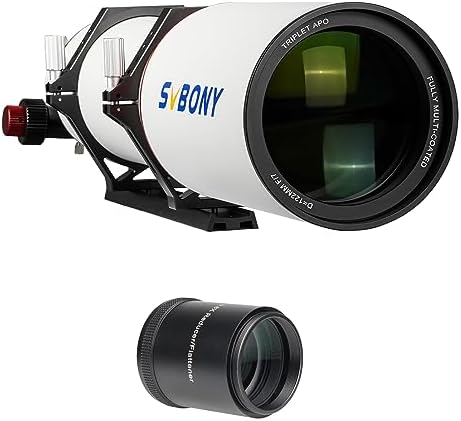
This bundle provides the SVBONY SV550 OTA with an essential field flattener. It addresses field curvature issues for sharper images across the entire frame.
We may earn a commission when you buy through this link, at no additional cost to you.
The SV209 flattener ensures the field is flat for full-frame cameras. This is crucial for capturing wide fields without star distortion at the edges.
The 180mm dovetail plate adds stability to the setup. The 5.0 rating reflects high satisfaction with the optical quality and included accessories.
This is a top choice for astrophotographers seeking a ready-to-image solution. It simplifies the setup process for capturing deep-sky objects.
The included flattener ensures that stars remain sharp across the full frame without vignetting or distortion.
The hollow 180mm dovetail plate provides a stable mount point for accessories while keeping the weight manageable.
We may earn a commission when you buy through this link, at no additional cost to you.
This bundle combines the large aperture SV550 122mm with a focal reducer and flattener. It offers a complete solution for serious deep-sky imaging enthusiasts.
We may earn a commission when you buy through this link, at no additional cost to you.
The 0.8X focal reducer shortens the effective focal length for wider fields. The flattener ensures sharpness across the edges for full-frame sensors.
With a 5.0 rating, users are highly satisfied with the performance and completeness of the package. It saves the trouble of sourcing accessories separately.
This package is ideal for those who want a ready-to-go imaging rig. It provides both the aperture and the necessary optics for high-quality photos.
The focal reducer allows for capturing larger deep-sky objects that might not fit in the narrower field of the native focal length.
Everything needed for prime focus imaging is included, making it easier to start capturing the night sky quickly.
We may earn a commission when you buy through this link, at no additional cost to you.
This kit offers the powerful SV550 122mm telescope with essential accessories. It is designed for those prioritizing image quality and depth in their astronomy.
We may earn a commission when you buy through this link, at no additional cost to you.
The included reducer and dovetail base streamline the imaging process. The large aperture allows for high limiting magnitude to capture fainter objects.
While the weight is higher, the handle makes it easier to transport. It is a robust choice for dedicated photographers looking for superior optics.
This kit is recommended for serious astronomers willing to invest in performance. It delivers excellent results for deep-sky photography.
The 122mm aperture gathers significant light, revealing faint details in distant galaxies and nebulae.
The included accessories ensure that setting up for imaging is straightforward and efficient.
We may earn a commission when you buy through this link, at no additional cost to you.
The SVBONY SV550 80 Kit is an excellent entry point for apochromatic refractors. It provides the core optical performance and necessary flattening accessories.
We may earn a commission when you buy through this link, at no additional cost to you.
The full multilayer coated lens ensures bright and clear images. It supports full-frame cameras for wide fields of view.
While it is a kit, it may lack some additional accessories like a finder scope. However, the optical quality is high enough for serious learning and imaging.
This is perfect for those starting their astrophotography journey. It balances performance with affordability for new users.
The fully multilayer coated lens ensures high transmission and minimal reflection for crisp images.
Supports full-frame sensors, allowing for large imaging formats without the need for specialized crop sensors.
We may earn a commission when you buy through this link, at no additional cost to you.
This kit includes the 122mm telescope along with a guide scope and camera. It is designed for those who want a turnkey solution for imaging.
We may earn a commission when you buy through this link, at no additional cost to you.
The SV905C camera is sensitive and compact, perfect for autoguiding. The guide scope ensures accurate tracking during long exposures.
While the setup is complex and heavy, the capabilities are immense. It allows for capturing deep-sky objects with high precision.
This is the ultimate kit for serious imaging enthusiasts. It saves the hassle of matching different components and ensures compatibility.
Includes both the main scope and guiding tools, allowing you to start imaging right out of the box.
The guide scope and camera work together to track faint stars accurately for long exposure imaging.
We may earn a commission when you buy through this link, at no additional cost to you.
Choosing the right apochromatic refractor requires balancing optical quality, aperture, and budget. Here are key factors to consider.
Aperture determines light gathering and resolution. Larger apertures like 122mm reveal fainter details, while 80mm offers portability and sharper high-contrast images.
Choose an aperture that matches your observation targets and transport needs.
Look for triplet designs with ED glass such as S-FPL51 or FCD1. These provide superior color correction and eliminate purple fringing common in doublet scopes.
Triplet air-spaced optics generally offer the best color performance for both visual and imaging.
Focal ratio impacts exposure times and field of view. F6 and F7 ratios are versatile for deep-sky targets, while F8 is better for planetary details.
A shorter focal ratio allows for wider fields but requires shorter exposures.
Bundles with field flatteners or reducers simplify astrophotography. Ensure compatibility with your sensors to avoid edge distortions.
Check if the kit includes necessary adapters for your camera.
Look for features like dovetail plates and ergonomic handles. A stable mounting interface is crucial for accurate alignment and transport.
Ensure the handle and base are sturdy enough for your setup.
High-quality machining and materials like magnesium reduce weight while maintaining rigidity. A robust build ensures longevity and consistent performance.
Inspect the focus mechanism for smoothness and precision.
Weight and size matter for travel. Compact scopes like the Askar 71F are ideal for remote sites, while larger models offer more detail.
Consider how often you plan to transport the telescope.
Ensure the OTA supports your camera format, whether full-frame or half-frame. Field flatteners often adjust back focus to meet specific requirements.
Check the back focal length requirements before buying accessories.
Always allow your telescope to acclimate to outside temperatures before use. Thermal equilibrium prevents internal currents that can degrade image quality.
Use collimation tools to ensure optical elements are aligned. Adjustments should be made carefully according to manufacturer instructions for best results.
Protect your optics with dew shields and caps when not in use. Regular cleaning of the exterior and interior requires professional service to avoid scratches.
Apochromatic refractors use special low-dispersion glass to minimize chromatic aberration. This results in sharp, color-free images, unlike achromatic models that often show purple fringing.
Yes, for wide-field imaging with modern sensors, a field flattener is necessary to correct field curvature. It ensures stars remain sharp from the center to the edges.
Focal ratio determines exposure time and field of view. Lower ratios like F6 are great for deep-sky, while higher ratios suit planetary observation.
Absolutely. Apochromatic refractors provide high contrast and sharp details. Planetary surfaces and moons appear clear and well-defined with excellent optics.
Yes, many modern OTAs are designed for full-frame sensors. Just ensure you have the right reducer or flattener to match the back focus.
Use the built-in handles and protective cases. Secure the tube firmly on the mount and avoid sudden movements to keep alignment intact.
Most telescopes are not waterproof. Use dew shields and store the unit in a dry place to prevent damage. Keep electronics protected from moisture.
Essential accessories include a sturdy mount, eyepieces, and camera adapters. Field flatteners and reducers are recommended for high-quality astrophotography.
We have reviewed ten top apochromatic refractors ranging from budget-friendly 80mm options to premium 122mm imaging kits. Each offers distinct advantages for different needs.
Prioritize optical quality and build materials to ensure your investment lasts. Consider your specific goals whether visual observing or deep-sky photography.
Check current prices and availability before purchasing to get the best deal. Always verify compatibility with your existing gear to avoid unexpected costs.