
Entina Tina2C
4.4Editor score
Beginner friendly setup
WiFi and app control
STEM learning modules
This guide compares the top 3D printers for educational use, focusing on safety, ease of use, and learning features for students and classrooms.
Selecting the right 3D printer for educational use involves balancing safety, ease of use, and robust learning features. Modern educators need machines that empower students to explore design, engineering, and creativity without constant technical intervention or safety risks.
We evaluated ten top-rated models based on calibration ease, safety certifications, software ecosystems, and print quality. Our analysis prioritizes devices that minimize setup time and maximize hands-on learning opportunities for diverse age groups and skill levels.
Each pick highlights specific strengths for schools, makerspaces, or home learning. While features and pricing may shift, these models represent the current leaders in reliable, safe, and education-focused 3D printing technology available today.
4.4Editor score

4.7Editor score

4.6Editor score
The following table provides a side-by-side comparison of all ten selected 3D printers, highlighting key specifications and features relevant to educational environments.





The Bambu Lab A1 stands out as the top choice for educational 3D printing due to its exceptional speed and fully automated calibration system. With a rating of 4.7, it delivers high-speed precision that keeps students engaged while minimizing technical downtime for educators.
We may earn a commission when you buy through this link, at no additional cost to you.
Its key strength lies in the full-auto calibration process, which eliminates manual bed leveling and Z-offset adjustments. This feature ensures optimal performance for every print, allowing teachers to focus on curriculum rather than machine maintenance. The active flow rate compensation further enhances print quality.
While the A1 lacks an enclosed chamber and requires purchasing AMS lite for multi-color printing separately, these trade-offs are acceptable for most educational settings focused on single-material learning. The quiet operation makes it suitable for classrooms without disturbing other activities.
Teachers seeking a reliable, fast, and easy-to-use printer should choose the A1. Its user-friendly interface and simplified touchscreen make it accessible for beginners, ensuring a seamless printing experience that empowers students to create complex designs confidently.
The full-auto calibration handles all processes automatically, ensuring precise Z-offset and bed-leveling without manual intervention.
With 10,000 mm/s2 acceleration, the A1 delivers blazing-fast prints while active noise canceling keeps the environment quiet.
We may earn a commission when you buy through this link, at no additional cost to you.
The Entina Tina2C is a standout budget option for educational 3D printing, designed specifically for kids and first-time users. With a rating of 4.4, it emphasizes simplicity and learning, allowing users to begin printing within just eight minutes of unboxing.
We may earn a commission when you buy through this link, at no additional cost to you.
Its AI-powered creativity features and extensive library of over 3000 models provide endless inspiration for students. The Poloprint Cloud app offers interactive STEM courses and creative modules, turning the printing process into an engaging educational experience that supports design thinking skills.
While the compact build volume limits larger projects and advanced features are minimal compared to professional units, these constraints are ideal for focused classroom activities or home learning. The flexible magnetic build plate and quick-swap printhead simplify maintenance for novices.
For educators seeking an affordable, safe, and education-focused printer, the Tina2C is an excellent starting point. Its guided setup and WiFi flexibility ensure that students can adapt to different workflows while reducing material waste through power-loss recovery.
Fully optimized for beginners, the Tina2C allows users to start their first 3D print in as fast as eight minutes.
The Poloprint Cloud app provides 20+ creative modules and regularly updated STEM learning courses for interactive education.
We may earn a commission when you buy through this link, at no additional cost to you.
The Ugee Funbox represents the premium end of educational 3D printing, offering safety and AI-driven creativity for kids. With a rating of 4.6, it combines a fully enclosed body with UL GREENGUARD certification to ensure clean air and safe operation in classrooms.
We may earn a commission when you buy through this link, at no additional cost to you.
Its standout quality is the integration of four AI engines that transform text, photos, and voice into printable models instantly. This feature turns screen time into hands-on making, providing a growing library of over 12,000 toys for endless DIY fun and design challenges.
While it only supports single-color PLA printing and comes at a higher price, these limitations encourage planning and assembly skills. The built-in camera streams live progress and creates time-lapse videos, fostering pride in creation and sharing achievements with family.
For schools prioritizing safety, engagement, and ease of use, the Funbox is the ultimate choice. Its zero calibration setup and intuitive UFun App make it accessible for independent student use without adult intervention.
Certified to UL GREENGUARD Gold low-emission standards, the Funbox captures ultrafine particles and ensures non-toxic materials.
Four AI engines allow kids to snap photos or speak ideas and watch them become real 3D toys in minutes.
We may earn a commission when you buy through this link, at no additional cost to you.
The Bambu Lab P1S offers an enclosed design suitable for advanced educational projects requiring higher temperature filaments. With a rating of 4.5, it balances high-speed performance with the stability needed for consistent, successful prints in a school environment.
We may earn a commission when you buy through this link, at no additional cost to you.
Its lightning-fast printing speed allows students to focus on creating rather than waiting, while the automatic bed leveling simplifies the workflow. The ability to support a wide range of filaments like PLA, PETG, and ABS expands learning possibilities for material science.
Though AMS for multi-color printing is sold separately and some reinforced polymers are not recommended, the core functionality remains robust. The user-friendly design ensures a hassle-free assembly experience, making it ready for use in just fifteen minutes.
Educators needing a reliable, enclosed printer for varied materials should consider the P1S. Its speed and ease of setup make it a strong option for intermediate to advanced students looking to explore diverse engineering applications.
The fully enclosed body improves print performance for advanced filaments like ABS and ASA safely.
Set up in 15 minutes to spend more time printing and less time on technical assembly tasks.
We may earn a commission when you buy through this link, at no additional cost to you.
The FLASHFORGE Adventurer 5M delivers high-speed printing with a fully auto leveling system designed for efficiency and convenience. While it has a 3.9 rating, its technical specifications like 600mm/s travel speed and 280C extruder offer significant potential for educational prototyping.
We may earn a commission when you buy through this link, at no additional cost to you.
Its smart and efficient design includes quick 3-second nozzle changes and fast warm-up times, which reduce downtime between lessons. Real-time app monitoring allows educators to manage multiple printers remotely, ensuring seamless oversight of student projects.
Although user ratings vary and it lacks an enclosed chamber for safety, the CoreXY structure and vibration compensation ensure high precision. The dual-sided PEI platform provides easy removal and adaptability for various creative projects.
For programs focused on rapid prototyping and speed, the Adventurer 5M is a capable choice. Its automatic features and remote monitoring make it a solid option for tech-savvy teachers willing to manage its open-frame design.
Featuring CoreXY structure with 600mm/s speed, it maximizes efficiency and reduces production cycles effectively.
Monitor print progress and adjust settings remotely with the Flash Studio for a seamless effortless printing experience.
We may earn a commission when you buy through this link, at no additional cost to you.
The FLASHFORGE AD5M combines advanced technology with user-friendly features to meet the needs of both beginners and experts in education. With a 4.3 rating, it ensures reliable, low-noise performance and a stress-free creative journey for students.
We may earn a commission when you buy through this link, at no additional cost to you.
Its fully automatic one-click leveling system measures nozzle-to-build plate distance accurately, ensuring a flawless first layer every time. The patent quick-release nozzle simplifies maintenance, allowing nozzles to be swapped in as little as three seconds.
While the open frame design may require supervision for safety, the resume print feature and power loss recovery protect projects from interruptions. The enhanced control and efficiency through Orca-flashforge slicer and network monitoring support classroom management.
Educators looking for a precise and durable printer with quick maintenance options will appreciate the AD5M. Its stability and support for various nozzle sizes make it adaptable for different learning activities.
The CoreXY all-metal motion structure ensures high-speed printing without compromising quality or stability.
Flash Maker APP allows device management, monitoring, and remote print status viewing from anywhere.
We may earn a commission when you buy through this link, at no additional cost to you.
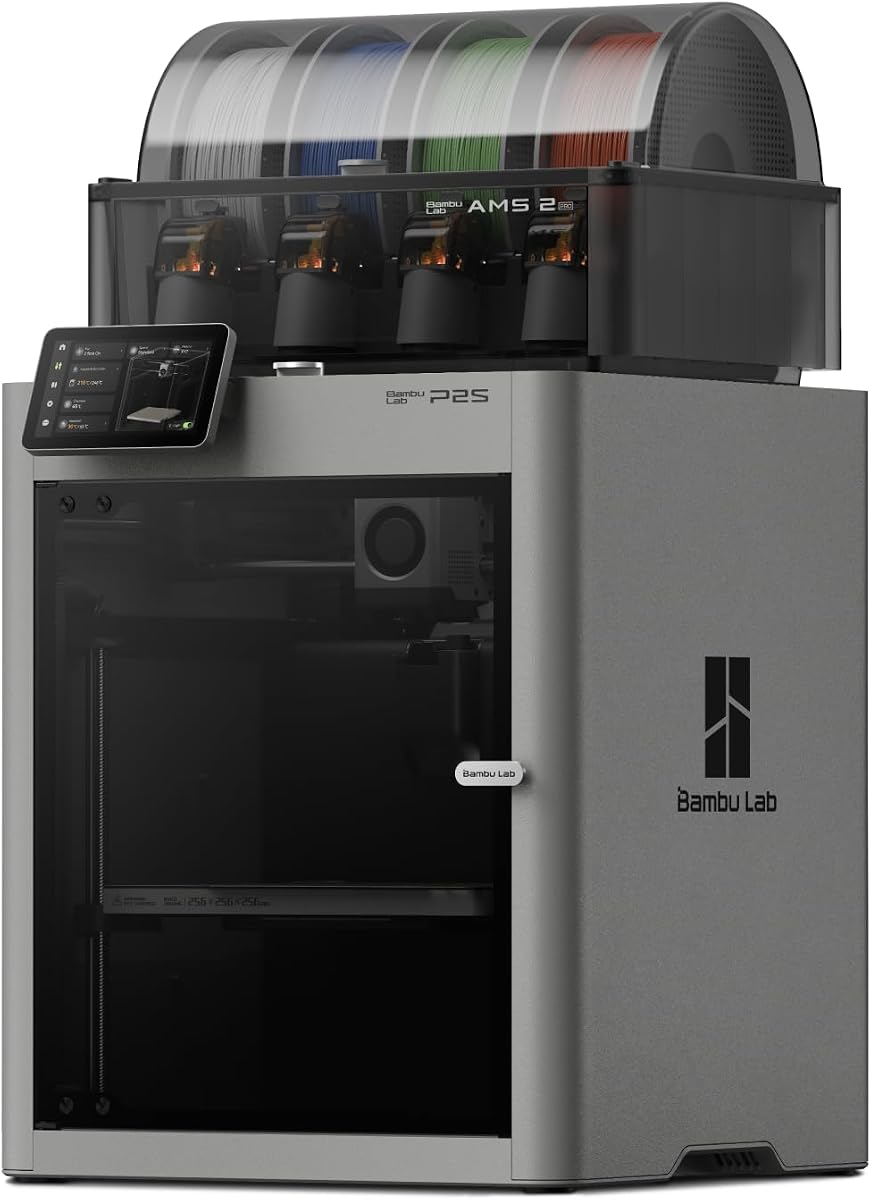
The Bambu Lab P2S Combo offers professional-grade capabilities for advanced educational projects requiring multi-color and multi-material printing. With a 4.7 rating, it combines high-speed precision with an adaptive airflow system for consistent results.
We may earn a commission when you buy through this link, at no additional cost to you.
The AMS 2 Pro enables effortless multi-color printing with built-in filament drying, keeping spools ready for flawless prints. Smart airflow balances cooling and heat retention, ensuring overhangs remain crisp and engineering materials maintain a stable temperature.
While the premium price point may be high for general use, the combo package simplifies workflow and reduces waste. AI failure detection and automatic calibration ensure professional-quality prints with minimal user intervention.
For advanced programs or makerspaces needing versatile, high-performance printing, the P2S Combo is a top choice. Its ability to handle complex workflows empowers students to create functional, detailed parts efficiently.
The AMS 2 Pro enables seamless multi-color/multi-material printing with built-in filament drying up to 65 degrees C.
Balances cooling and heat retention automatically to ensure consistent results for any filament type.
We may earn a commission when you buy through this link, at no additional cost to you.
This FLASHFORGE Adventurer 5M model emphasizes speed and precision with vibration compensation and a robust design. With a 4.3 rating, it delivers exceptional quality and a perfect first layer, making it suitable for reliable educational printing sessions.
We may earn a commission when you buy through this link, at no additional cost to you.
The ultra-fast CoreXY structure with high acceleration ensures minimal waiting time, allowing students to see results quickly. Filament run-out sensors and power loss recovery features eliminate common frustrations, ensuring that interrupted prints can resume seamlessly.
As an open printer, it is best used in well-ventilated environments for safety. The removable PEI steel plate supports various materials, providing flexibility for different types of creative projects.
Educators prioritizing speed and consistent quality should consider this model. Its ability to minimize failure through sensors and recovery features makes it a practical choice for busy classrooms.
With CoreXY acceleration up to 20000 mm/s2, it achieves maximum speed with minimal acceleration time.
Resume prints after outages to save ongoing layers and continue when power is restored automatically.
We may earn a commission when you buy through this link, at no additional cost to you.
The Snapmaker U1 introduces a revolutionary 4-toolhead system that enables true multi-material and multi-color printing without manual swaps. With a 4.5 rating, it significantly reduces waste and speeds up multi-color projects through automated tool changes.
We may earn a commission when you buy through this link, at no additional cost to you.
Its smart calibration and AI-powered print monitoring ensure smooth, accurate prints, while the open-source software offers customization for advanced users. The rigid CoreXY motion system maintains stability at high speeds, enabling detailed and functional prototypes.
Although the premium price and complexity may challenge beginners, the ability to mix flexible and rigid materials opens up engineering possibilities. The built-in model library simplifies the journey from design to finished print.
For technical programs exploring material science and complex assembly, the Snapmaker U1 is ideal. Its efficiency and versatility make it a powerful tool for professional and advanced student creators.
Toolhead swapping instead of filament purging reduces waste up to 5X and printing speeds up to 5X faster.
Combines rigid and flexible materials or water-soluble supports in a single print with automatic tool switching.
We may earn a commission when you buy through this link, at no additional cost to you.
The Bambu Lab A1 Mini Combo offers a compact solution with full-auto calibration and multi-color capabilities. With a 4.2 rating, it delivers high-speed precision and quiet operation suitable for smaller educational spaces or individual student use.
We may earn a commission when you buy through this link, at no additional cost to you.
Its seamless workflow includes active flow rate compensation for smooth prints and a simplified touchscreen for easy control. The multi-color printing with AMS lite allows vibrant designs without needing a separate AMS unit.
While the build volume is small compared to standard printers, its efficiency and ease of use make it ideal for detailed, small-scale projects. Setup takes about twenty minutes, allowing quick deployment in classrooms.
Educators needing a compact yet powerful printer should consider the A1 Mini. Its quiet operation and intuitive interface ensure that students can focus on design and creation without technical distractions.
Experience a quiet printing environment with active motor noise cancellation ensuring noise levels stay low.
The A1 Mini 3D printer takes care of all calibration processes automatically for optimal performance.
We may earn a commission when you buy through this link, at no additional cost to you.
Choosing the right 3D printer for education requires careful evaluation of safety features, ease of use, and software ecosystems to support learning goals.
For educational settings, safety is paramount. Look for printers with fully enclosed bodies to prevent contact with hot parts and contain emissions. Ensure the unit carries relevant safety certifications such as UL or GREENGUARD to verify low emissions and material safety.
Enclosed designs are crucial for classrooms to maintain air quality and prevent accidental burns. Always prioritize safety standards over raw speed when selecting machines for younger students.
Educators need machines that minimize downtime. Choose printers with automatic bed leveling and calibration to eliminate manual adjustments. This ensures students can focus on design and learning rather than troubleshooting technical issues.
Automatic calibration is the standard for modern educational printers. A hassle-free setup allows teachers to manage multiple devices efficiently without extensive technical knowledge.
Time is a critical resource in education. Faster printers reduce wait times, allowing more students to complete projects within a class period. Look for models with high travel speeds and acceleration to keep pace with curriculum demands.
While speed is important, ensure it does not compromise quality. A balance between high-speed performance and precision ensures that student creations are successful and motivating.
Educational printers should offer robust software support. Look for platforms that include libraries of pre-designed models, STEM courses, and intuitive slicing software. This support helps students learn design principles without needing to master complex CAD tools immediately.
A strong ecosystem provides resources for guided learning. Integrated apps and online libraries turn the printer into a comprehensive learning tool rather than just a hardware device.
Consider the size of projects students will create. A sufficient build volume allows for detailed models, while material compatibility like PLA, PETG, or ABS expands engineering possibilities. Ensure the printer supports materials that are safe and easy to handle.
Versatility in material support encourages experimentation. Choose a printer that can handle the filament types required for your specific educational programs or STEM curriculum.
Schools require durable machines that withstand frequent use. Look for features like tool-less nozzle changes, robust metal frames, and reliable power-loss recovery. These features extend the printer's life and reduce repair costs.
Easy maintenance ensures that educators spend more time teaching than fixing machines. Prioritize models with proven track records of reliability and accessible support.
Remote monitoring and control are valuable for classrooms with multiple printers. WiFi connectivity, mobile apps, and cloud integration allow teachers to manage projects without being physically present at every machine.
Seamless connectivity supports flexible teaching styles. It enables students to submit files from personal devices and receive updates on their print progress.
Consider both the upfront cost and ongoing expenses like filament and spare parts. While premium printers offer better features, budget models may suffice for basic learning. Evaluate the cost per print and potential savings from reduced failures.
A clear budget plan ensures sustainable education programs. Investing in reliable machines can reduce long-term costs by minimizing failed prints and repairs.
Begin by placing the printer on a stable surface with proper ventilation. Connect it to a power source and install the recommended software or app. Always calibrate the bed using the auto-leveling feature if available before starting any print.
Regularly clean the nozzle and check filament levels to avoid interruptions. Use the slicing software to prepare your 3D models with appropriate settings like layer height and infill. Keep spare parts like nozzles and build plates on hand for quick replacements.
After printing, allow the build plate to cool before removing objects to prevent warping. Clean the print bed with recommended solutions to maintain adhesion. Store filament in a dry place to avoid moisture absorption and potential clogs.
Yes, modern 3D printers designed for education include safety features like enclosed bodies and safety certifications. Always supervise younger students and ensure proper ventilation. Choose models with UL or GREENGUARD certification to minimize risks associated with hot surfaces and emissions.
Educational printers typically require about 2×2 feet of table space. Consider footprint, height, and cable access when planning. Compact mini models are available for classrooms with limited space while still providing robust features.
PLA is the most common and safest filament for schools due to its low emissions and ease of use. PETG and ABS may be used for engineering lessons but require ventilation. Always choose filaments compatible with your specific printer model.
Regularly clean the nozzle and check for wear on belts and parts. Lubricate moving parts if required by the manufacturer. Keep firmware updated and run calibration tests weekly. Having a maintenance schedule ensures consistent performance and longevity.
Yes, many modern printers offer remote monitoring via mobile apps and WiFi. Students can start prints from home while teachers oversee progress. However, safety supervision is still necessary when students operate printers alone.
Look for UL or GREENGUARD Gold certifications to ensure low emissions and safety. These standards verify that the printer and materials meet rigorous safety guidelines for indoor use. Certification is critical for classroom safety compliance.
With proper maintenance, educational 3D printers can last several years of frequent use. High-quality components like metal frames and reliable extruders extend lifespan. Regular care and timely part replacements ensure continuous operation.
Most modern educational printers offer optional WiFi connectivity for cloud features but can function offline via SD card. Check if your curriculum relies on online libraries. Offline capability ensures printing can continue even without network access.
The 3D printer for educational use market offers diverse options tailored to different needs and budgets. From the Bambu Lab A1 for speed to the Ugee Funbox for AI-driven learning, these printers empower students to explore creativity and engineering hands-on.
Prioritize safety, ease of use, and educational ecosystem when making your decision. Ensure that the chosen model supports your curriculum goals and provides a reliable experience for both teachers and students in busy classrooms.
Always check current specifications and availability as technology evolves rapidly. Investing in the right equipment can transform your educational environment and provide students with invaluable practical skills for the future.