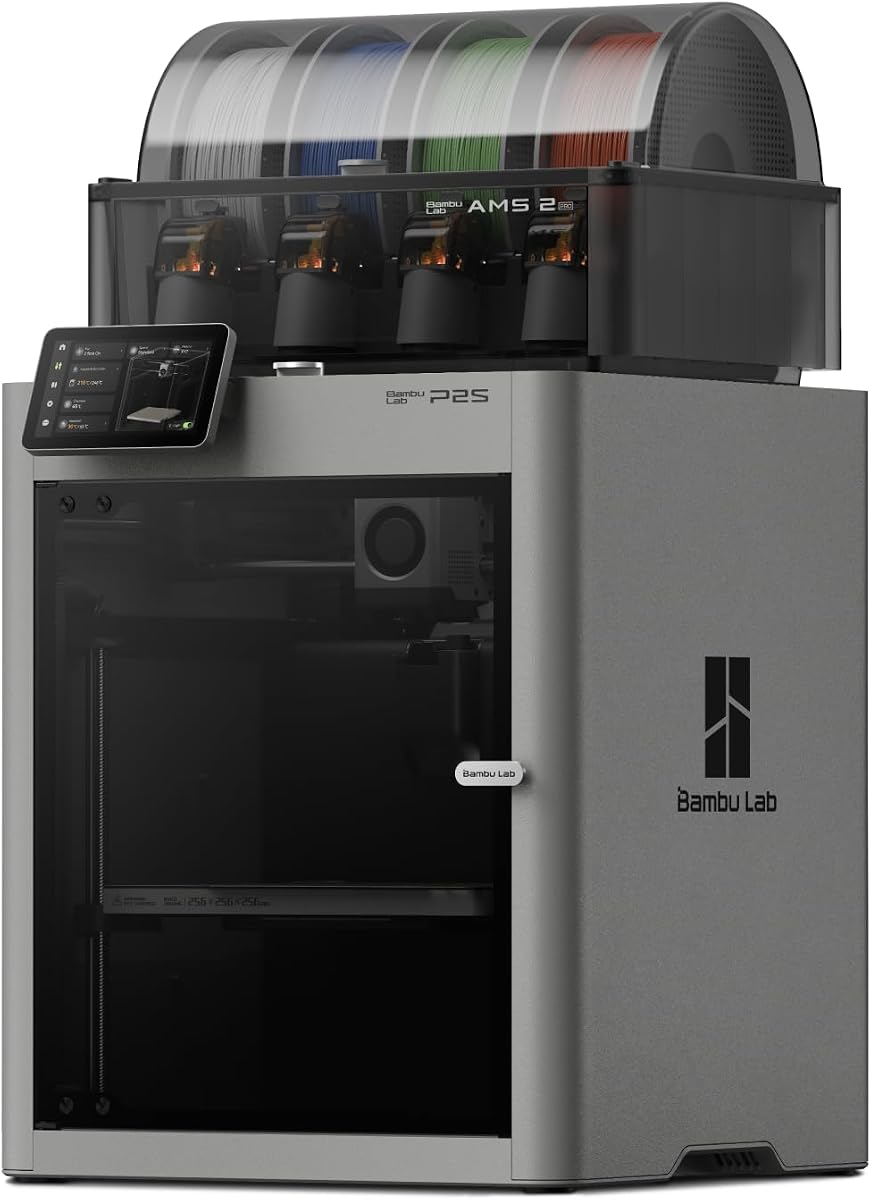
Bambu Lab P2S Combo, P2S 3D Printer & AMS 2 Pro, Multi-Color 3D Printing
4.7Editor score
High-speed precision printing
Ready to print quickly
Smart airflow system
Discover the top 10 3D Printer for Engineering Prototypes models compared for speed, accuracy, and material versatility to accelerate your design workflow in
Selecting the right 3D Printer for Engineering Prototypes is critical for teams needing rapid iteration and high fidelity. The best machines balance speed with precision while supporting diverse materials like engineering-grade plastics and composites.
This guide evaluates ten leading models based on build volume, heating capabilities, motion systems, and multi-material support. We prioritize features that reduce waste, improve adhesion, and ensure reliable results for functional testing.
Each pick highlights key strengths and trade-offs to help you match a machine to your specific prototyping needs. Prices and availability change frequently, so verify current offers before purchasing to ensure you get the best value.
4.7Editor score

3.5Editor score

4.4Editor score
The following table provides a side-by-side comparison of all ten models. It highlights key specifications such as build volume, max speed, chamber heating, and unique features to help you identify the best fit for your engineering needs quickly.





The Original Prusa XL stands out as a top-tier choice for engineering prototyping due to its robust dual-toolhead system and large-format capabilities. It holds a solid reputation in the professional community for reliability and precise multi-material handling.
We may earn a commission when you buy through this link, at no additional cost to you.
Its CoreXY motion system ensures stability during complex prints, while the segmented heated bed improves energy efficiency and reduces warping. This combination allows teams to produce functional prototypes with soluble support structures reliably without constant intervention.
Trade-offs include the need for some assembly upon arrival and a premium price compared to entry-level units. However, the lifetime technical assistance and streamlined workflows justify the investment for serious engineering environments requiring consistent results.
This printer is ideal for engineering teams and advanced makers needing reliable industrial-grade performance at scale. If your work involves intricate multi-material designs, the Prusa XL delivers the precision and support necessary for successful prototyping.
Intelligent tool switching minimizes purge waste while maintaining high-quality transitions between materials for cleaner prints.
Prusa Research offers lifetime technical assistance and 24-hour professional customer service for uninterrupted operations.
We may earn a commission when you buy through this link, at no additional cost to you.
The Bambu Lab P2S Combo offers exceptional value for engineering teams needing speed and reliability without breaking the bank. With its high-speed precision and seamless multi-color printing capabilities, it accelerates design iteration cycles significantly.
We may earn a commission when you buy through this link, at no additional cost to you.
Features like AI failure detection, automatic calibration, and a built-in filament drying system ensure consistent results. The adaptive airflow system balances cooling and heat retention, making it suitable for a wide range of filament types including engineering-grade materials.
While it excels in performance, it may require careful temperature management for highly demanding industrial polymers compared to fully enclosed units. These minor constraints are acceptable given its overall efficiency and ease of use for most prototyping tasks.
This model is perfect for professionals and beginners who want professional-grade 3D printing effortlessly. Its ability to handle complex designs quickly makes it a smart investment for workshops needing versatile output without heavy overhead.
Set up your printer and start printing in just 15 minutes for immediate productivity.
Built-in filament drying keeps every spool ready for flawless prints and extends material life.
We may earn a commission when you buy through this link, at no additional cost to you.
The QIDI Max4 Combo is designed for industrial engineers needing to print large parts or complex molds in one go. Its ultra-large build volume and active heated chamber provide a robust foundation for producing high-performance prototypes reliably.
We may earn a commission when you buy through this link, at no additional cost to you.
With closed-loop motors and a high-flow hotend, it achieves impressive speeds while maintaining accuracy. The system supports abrasive materials like carbon fiber-reinforced nylon, making it versatile for tough engineering applications and durable end-use parts.
Users must purchase the Polar Cooler separately for optimal high-temp performance, which adds to the total cost. This trade-off is manageable for teams prioritizing build size and material versatility, ensuring they can tackle projects other printers cannot handle.
Choose this printer if you need to print large industrial parts without splitting models. Its stability and compatibility with aggressive materials make it a powerful tool for advanced prototyping and custom manufacturing workflows.
Print life-size prototypes and furniture components on this extra-large 3D printer ideal for engineers.
Closed-loop motors and lead screws reduce vertical gaps ensuring smooth and precise printing results.
We may earn a commission when you buy through this link, at no additional cost to you.
The Snapmaker U1 revolutionizes prototyping with its unique four-toolhead system enabling rapid material swaps without purging. This capability drastically reduces waste and speeds up production, making it ideal for iterative engineering designs requiring multiple materials.
We may earn a commission when you buy through this link, at no additional cost to you.
Its automatic tool changer reduces swap time to just five seconds, allowing seamless transitions between rigid and flexible filaments. The system supports everything from water-soluble supports to TPU, offering great design freedom for functional prototypes.
The build volume is moderate compared to large industrial machines, which limits its use for very large single-piece parts. However, the speed and efficiency gains in multi-material workflows often outweigh this limitation for most engineering teams.
Buy this if you need efficient multi-color and multi-material printing for functional parts. Its ability to handle complex combinations effortlessly makes it a standout choice for creators valuing speed and reduced operational costs.
Four independent toolheads automatically switch between materials with no manual intervention for faster workflows.
Swapping toolheads minimizes waste reducing filament waste by up to 5X for lower costs.
We may earn a commission when you buy through this link, at no additional cost to you.
The Bambu Lab A1 delivers high-speed precision in an accessible package suitable for small offices or home setups. Its full-auto calibration and active flow rate compensation ensure quality prints without manual hassle, saving valuable engineering time.
We may earn a commission when you buy through this link, at no additional cost to you.
It supports multi-color printing with the optional AMS lite, allowing vibrant designs and multi-material tests. The user-friendly interface and quiet motor noise canceling make it a pleasant addition to any workspace where noise matters.
Being an open-frame machine, it may struggle with warping on certain engineering materials like ABS without additional enclosure. This limitation makes it best for PLA or PETG prototypes where environmental control is less critical.
Choose this for quick prototyping on a budget where simplicity is key. Its speed and reliability offer excellent value for beginners or small teams needing consistent results for non-critical design validation.
The printer takes care of all calibration processes automatically ensuring optimal performance every time.
Active flow rate compensation actively compensates the flow rate according to readings for accurate extrusion.
We may earn a commission when you buy through this link, at no additional cost to you.
The FLASHFORGE Creator 5 Pro is engineered for industrial settings needing robust multi-material and color capabilities without wasting filament. Its 4-toolhead system switches nozzles without flushing, drastically slashing operational overhead for high-volume prototyping.
We may earn a commission when you buy through this link, at no additional cost to you.
A fully enclosed frame with a 65°C active heated chamber allows printing with tough materials like ABS and PC reliably. The dual HEPA and activated carbon system maintains a clean environment, making it safe for office deployment.
Its compact build volume may limit use for large single-piece parts compared to other models in this category. However, the efficiency and material versatility it offers for complex components make it a strong contender for specialized industrial use.
This printer is recommended for teams needing efficient multi-color workflows with minimal cleanup. Its focus on waste reduction and material safety positions it as a smart choice for sustainable and safe industrial prototyping.
Switches nozzles without flushing filament completely eliminating massive purge waste and reducing material costs.
Dual HEPA 13 and activated carbon system effectively traps ultrafine particles and fumes for a safe workspace.
We may earn a commission when you buy through this link, at no additional cost to you.
The Bambu Lab P1S balances speed, quality, and enclosure features effectively for general engineering prototyping. Its fully enclosed body improves performance for advanced filaments like ABS and ASA while maintaining stability during high-speed printing.
We may earn a commission when you buy through this link, at no additional cost to you.
With 500mm/s speeds and active flow compensation, it delivers crisp layers and smooth finishes quickly. The optional AMS integration allows multi-color printing, giving designers more freedom to create functional prototypes with clear indicators.
It does not recommend carbon fiber reinforced polymers which limits some high-strength industrial applications. For most standard engineering plastics, however, its reliability and speed provide a solid platform for iterative design work.
Pick this for its blend of speed and ease of use. It is a dependable choice for teams needing fast turnaround on standard prototypes without managing complex multi-material workflows.
Fully enclosed body improves print performance for advanced filaments like ABS and ASA reliably.
Lightning-fast printing speed lets you focus on creating not waiting for your masterpieces.
We may earn a commission when you buy through this link, at no additional cost to you.
The FLASHFORGE Adventurer 5M Pro focuses on versatility with quick nozzle swaps for various layer heights and materials. This feature makes it flexible for teams needing to switch between fine details and robust prototypes rapidly without tools.
We may earn a commission when you buy through this link, at no additional cost to you.
Its high-speed printing and active vibration compensation ensure smooth surface finishes even at high speeds. The quiet enclosure makes it suitable for office environments where noise control is important for team productivity.
Lack of native multi-color support limits its use for complex multi-material prototypes compared to dual-head units. However, for standard high-temperature parts requiring fast iteration, its convenience and performance are hard to match.
Choose this if you need fast, reliable printing with flexible nozzle options. It is ideal for workshops needing to adapt quickly to different design requirements without heavy manual intervention.
Features a tool-free quick-release nozzle mechanism for effortless 3-second replacements across multiple sizes.
Powered by low-noise motion control it operates quietly under 50dB for seamless use.
We may earn a commission when you buy through this link, at no additional cost to you.
The Anycubic Kobra 3 Max delivers a massive build volume and impressive speed at a competitive price point. It is ideal for engineers needing to print large parts or multiple components simultaneously without splitting models.
We may earn a commission when you buy through this link, at no additional cost to you.
With 600mm/s speeds and G-sensor vibration compensation, it maintains precision even at high throughput. Features like runout sensors and resume functions ensure long prints finish successfully which is critical for expensive or time-sensitive jobs.
It lacks advanced features like a heated chamber or multi-color capability, which limits use for high-performance polymers. For standard prototyping with PLA, PETG, or basic engineering materials, it offers excellent value and reliability.
Buy this for its large size and speed. It is a practical choice for teams needing to produce large-scale prototypes efficiently without breaking the budget.
Industry-leading build volume allows life-size prototypes and furniture components in one go.
Achieve professional-grade precision even at blazing 600mm/s speeds with vibration compensation.
We may earn a commission when you buy through this link, at no additional cost to you.
The FLASHFORGE Creator 5 Pro Industrial prioritizes user safety and efficiency with advanced filtration and active chamber heating. It ensures consistent interlayer adhesion even in varying room temperatures for reliable engineering results year-round.
We may earn a commission when you buy through this link, at no additional cost to you.
Four independent extruders enable true multi-color printing without cross-contamination or purging delays. This capability combined with high-speed printing allows teams to produce polished, functional prototypes quickly and safely.
Its build volume is more limited compared to other industrial options, which might constrain large part production. However, for smaller, high-detail prototypes requiring color and precision, its features are robust and effective.
This model suits offices needing safe, clean, and colorful prototypes. Its focus on environmental control and speed makes it an excellent choice for professional environments prioritizing quality and safety.
HEPA13 internal recirculation filter effectively captures volatile particles and odors during printing.
Four completely independent toolheads switch colors by swapping nozzles instantly without purging.
We may earn a commission when you buy through this link, at no additional cost to you.
Choosing the right 3D Printer for Engineering Prototypes depends on your specific material, size, and budget needs. This guide outlines key factors to help you select a machine that matches your engineering workflow requirements accurately.
The build volume determines the maximum size of prototypes you can print without assembly. For engineering teams producing large functional parts or multiple components at once, a larger volume minimizes the need for splitting models and reassembling.
Always choose a machine with a build area that comfortably fits your largest expected prototype dimensions to save time and maintain structural integrity.
Engineering prototypes often require specialized materials like ABS, PETG, Nylon, or carbon fiber-reinforced composites. Ensure the printer supports these materials with appropriate nozzle temperatures and enclosure options to prevent warping and ensure durability.
Look for printers with high-temperature hotends and heated chambers if you plan to work with advanced industrial polymers regularly.
Multi-material capability allows for prototypes combining rigid and flexible parts or using soluble supports. This feature accelerates validation by creating complex functional models in one print run rather than multiple steps.
Consider dual-toolhead systems or advanced extruders if your workflow involves detailed multi-component assemblies frequently.
Fast print speeds reduce turnaround time for design iterations which is critical in engineering cycles. High acceleration and stable motion systems ensure speed does not come at the cost of accuracy or surface quality.
Prioritize models with vibration compensation and rigid frames to maintain precision at higher speeds for reliable results.
Automatic leveling and calibration features save significant time and reduce user error during setup. These are especially important for teams where operators may have varying levels of experience with 3D printing.
Choose printers with user-friendly interfaces and automated workflows to ensure consistent performance with minimal manual intervention.
An enclosed chamber helps maintain stable temperatures for warping-prone materials like ABS or Nylon. It also reduces noise and contains fumes making the machine safer for office or shared workspace environments.
Check for air filtration systems if you need to manage emissions during long print runs.
Strong software support streamlines the workflow from design to print. Look for printers compatible with professional slicers and remote monitoring tools to manage jobs efficiently without constant physical presence.
Integrated apps and cloud features allow for real-time updates and remote control which improves productivity.
Reliable technical support and active communities can resolve issues quickly during critical projects. Warranty terms and availability of replacement parts also affect long-term usability and total cost of ownership.
Select brands known for responsive support and clear documentation to minimize downtime when technical challenges arise.
Start by leveling the build plate and selecting the correct nozzle temperature for your chosen material. Proper calibration ensures the first layer adheres well which is critical for structural integrity in engineering prototypes.
Clean the print bed regularly to remove dust or residue that might affect adhesion. Use appropriate solvents like isopropyl alcohol to maintain a clean surface and prevent failed prints.
Store filaments in dry environments to prevent moisture absorption which degrades print quality. Regularly lubricate moving parts and inspect belts or motors to ensure consistent performance over time.
PETG, ABS, and Nylon are commonly used for their durability and temperature resistance. Composite materials like carbon fiber-reinforced nylon offer enhanced strength for functional testing in demanding environments.
Yes, an enclosure helps maintain stable temperatures to prevent warping with materials like ABS or Polycarbonate. It also contains fumes and reduces noise, making it safer for indoor use.
Multi-material printers allow complex designs with soluble supports or color changes in one print. Single-extruder units are simpler and cheaper but require manual swaps limiting workflow flexibility.
Select a volume that exceeds your largest prototype dimensions by at least 10%. This allows for proper support structures and minimizes the need to split large models.
Modern high-speed models maintain quality with vibration compensation and rigid frames. However, fine details may still require slower speeds depending on your specific tolerance requirements.
No, engineering printers require specific nozzles and temperatures. Always check compatibility for abrasive filaments like carbon fiber which need hardened steel nozzles to prevent wear.
Industry-standard slicers like PrusaSlicer, Cura, or Bambu Studio offer precise control over supports and infill. These tools help optimize prints for strength and material usage effectively.
Clean the print bed after every few prints and inspect belts monthly. Lubricate moving parts as recommended to prevent wear and ensure consistent motion accuracy.
We have reviewed ten top-performing 3D Printers for Engineering Prototypes ranging from large industrial models to agile desktop units. Each offers unique strengths in speed, material compatibility, and ease of use to suit various engineering needs.
Prioritize build volume and material support if you focus on functional testing. For rapid iteration, look for fast print speeds and automated calibration features that reduce manual workload.
Prices and promotions change frequently so always check current listings before buying. Ensuring you pick the right model for your budget and workflow will maximize productivity and project success in 2026.