
Power Queen Battery Balancer 48V
4.3Editor score
Universal battery compatibility
Low standby power draw
High temperature protection
Discover the top 10 battery equalizer balancers for 12V 24V and 48V systems. Compare active balancing features safety protections and battery compatibility to
Battery equalizer balancers are essential components for maintaining health in multi-battery systems. They ensure that each cell or module shares the load equally, preventing premature failure. Without them, voltage imbalances can drain your system faster and reduce overall efficiency significantly.
We evaluated ten leading models based on their voltage range, active balancing current, and protection features. Our analysis covers compatibility with various battery chemistries including lithium and lead acid. Each product offers unique benefits for RVs, solar setups, and marine applications requiring reliability.
Every pick includes detailed specs, pros, cons, and real-world application notes to help you decide. Prices fluctuate regularly due to supply chain dynamics and market demand. Always verify current listings before purchasing to ensure you get the best value and latest firmware version available.
4.3Editor score

4.3Editor score

4.2Editor score
This table provides a side-by-side look at every model we reviewed. It highlights key specifications like voltage range, battery type support, and specific protection mechanisms to help you narrow down your choice quickly.




The LiTime 48V Battery Balancer stands out as a top choice for active equalization. It offers robust protection and supports up to 48V systems with ease. Its ability to handle various chemistries makes it highly versatile for modern power needs.
We may earn a commission when you buy through this link, at no additional cost to you.
This unit features a 10A maximum working current which ensures fast voltage equalization. It automatically activates when differences exceed 10mV and enters standby mode to save power. Reverse polarity and high temperature protection add essential safety layers.
While the price point is moderate, the build quality justifies the investment. Some users may find the wiring setup slightly complex compared to simpler units. However, the comprehensive features make it a reliable long-term solution for complex banks.
Anyone building a 48V bank or upgrading an existing RV setup should consider this model. It is particularly useful for those needing consistent performance without frequent manual intervention. The combination of active balancing and safety makes it a smart pick.
The active balancing technology ensures all batteries charge uniformly reducing stress on individual cells.
Integrated protections against overheating and reverse polarity prevent common installation hazards effectively.
We may earn a commission when you buy through this link, at no additional cost to you.
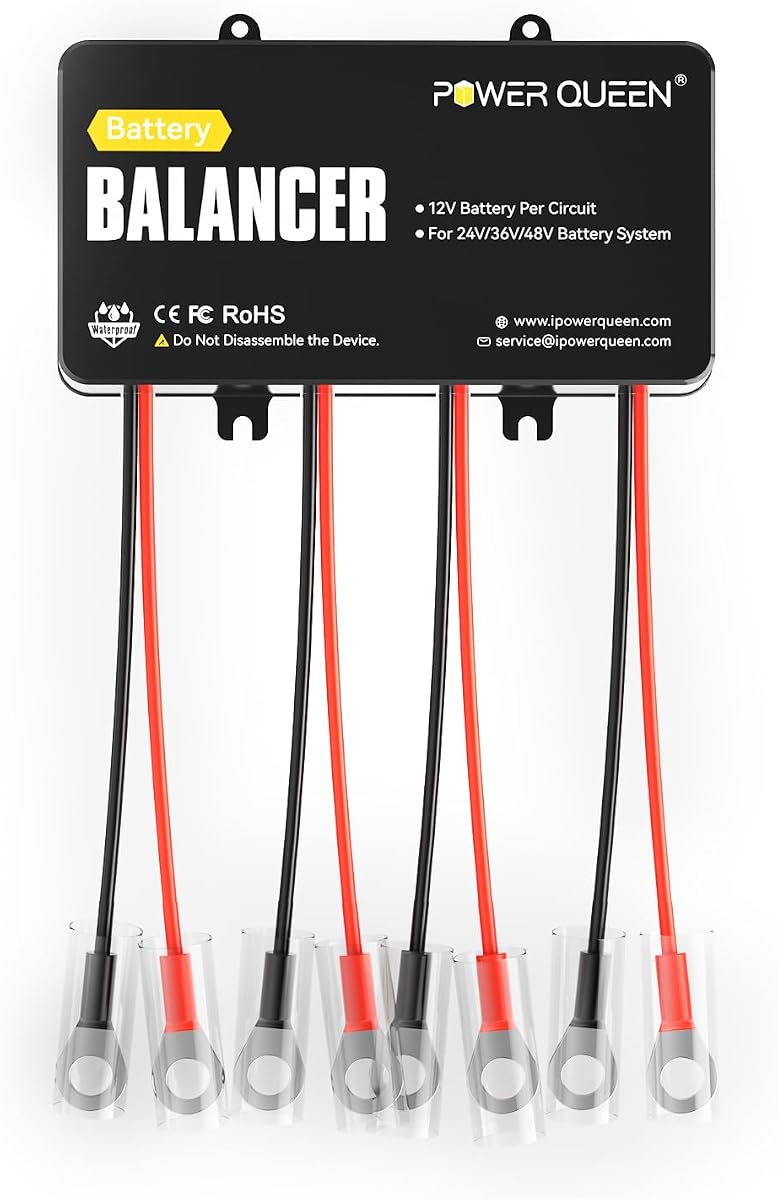
The Power Queen Battery Balancer 48V offers excellent value for budget-conscious buyers. It supports 24V through 48V systems with reliable active balancing technology. Users appreciate its straightforward installation and wide range of battery chemistry support.
We may earn a commission when you buy through this link, at no additional cost to you.
It activates automatically when voltage differences exceed 10mV to keep the bank balanced. Once the difference drops below that threshold, it switches to a low power standby mode. This ensures continuous monitoring without draining your power reserves unnecessarily.
While it lacks advanced display features, its core function is effective and durable. The high temperature protection adds a layer of security often missing in cheaper models. For many standard applications, this unit provides everything you need at a lower cost.
This model is ideal for DIYers looking for a cost effective solution for RV or solar setups. It works well for those who prioritize functionality over high-end features. If you need to balance a 48V bank without overspending, this is a strong choice.
Delivers reliable active balancing performance at a price point accessible to most hobbyists.
Auto activation ensures batteries stay balanced continuously without manual checking or intervention.
We may earn a commission when you buy through this link, at no additional cost to you.
Victron Energy is renowned for high quality power solutions and this balancer reflects that reputation. It focuses on stabilizing 24V systems by equalizing charge across series connected batteries. Its design prioritizes long term reliability and straightforward operation.
We may earn a commission when you buy through this link, at no additional cost to you.
It draws up to 1Amp from the higher voltage battery to balance the pair. Multiple units can be paralleled for larger systems like 48V banks making it scalable. This modularity allows you to customize the solution to your specific bank size.
The lower current output might seem limiting compared to newer active units but it is sufficient for many setups. The higher price reflects the brand quality and engineering robustness. Users who value proven performance over speed often prefer this unit for critical systems.
This balancer is best for users who already use Victron components or prioritize brand reliability. It is suitable for marine or off-grid applications where failure is not an option. If you need a trusted name with simple operation this model delivers well.
Victron is a trusted name in professional power systems ensuring high engineering standards.
Multiple units can be linked to support larger voltage configurations flexibly.
We may earn a commission when you buy through this link, at no additional cost to you.
This Battery Equalizer stands out for its ability to handle systems up to 96V making it unique. It supports both lead-acid and lithium chemistries making it versatile for mixed environments. The rail-type buckle installation simplifies mounting in distribution boxes.
We may earn a commission when you buy through this link, at no additional cost to you.
It maintains charge and discharge balance between batteries connected in series or parallel configurations. The wide voltage range makes it ideal for custom or industrial setups that exceed standard 48V limits. Its modular nature allows multiple units to work together seamlessly.
While it lacks detailed digital feedback it performs its core function reliably. The price point is very competitive compared to specialized high voltage units. For users needing a no-frills solution for high voltage banks this offers great utility.
This model is perfect for large battery groups in trucks or industrial equipment. If your setup requires balancing beyond 48V this unit offers a straightforward solution. Its simplicity and high voltage capability make it a niche but valuable tool.
Designed to support systems as high as 96V for specialized applications.
Rail-type buckle design makes installation in tight electrical boxes easier.
We may earn a commission when you buy through this link, at no additional cost to you.
The HC02 Balancer includes an LED display which provides immediate visual feedback on status. This is helpful for users who want to monitor operations without complex tools. It offers essential protections like low voltage disconnect to safeguard battery health.
We may earn a commission when you buy through this link, at no additional cost to you.
It connects directly to four 12V batteries in series or parallel configurations. The reverse polarity protection helps prevent damage during installation if wires are mixed up. While the rating is lower than others, it still offers key features at a reasonable cost.
Users should note that this model may require more careful installation to avoid errors. The lower rating suggests potential variability in quality or longevity. However, for budget projects needing visual confirmation it remains a viable option.
This unit is suitable for DIY installations where visual monitoring is a priority. If you want to see exactly what the balancer is doing without extra meters this works well. Just ensure you follow wiring instructions carefully to maximize its lifespan.
LED display allows users to quickly check operational status at a glance.
Low voltage disconnect and reverse polarity safety prevent common electrical failures.
We may earn a commission when you buy through this link, at no additional cost to you.
Redodo offers a dedicated 24V balancer that performs exceptionally well for 2x12V setups. Its 10A maximum equalization current ensures that voltage differences are corrected quickly. An LED display helps users track the voltage of connected battery strings easily.
We may earn a commission when you buy through this link, at no additional cost to you.
This model includes dual protection functions for high temperature and reverse connection safety. It comes with robust cables and M8 OT terminals for secure connections. A one-year warranty provides peace of mind for buyers investing in their power system.
While it is optimized for 24V systems it does not scale to 48V directly. This specialization makes it excellent for specific applications like trolling motors or small RVs. Users with larger banks may need to look elsewhere or use multiple units.
Choose this unit if you need a reliable solution for a 24V battery bank. Its combination of speed, visual feedback, and warranty makes it a strong competitor. For those focused on 24V systems this provides high performance and good support.
10A current capability allows for rapid correction of voltage imbalances.
M8 OT terminals ensure secure wiring reducing the risk of loose contacts.
We may earn a commission when you buy through this link, at no additional cost to you.
This Power Queen model mirrors the features of its 48V cousin but offers a different form factor. It maintains active balancing that activates automatically when voltage discrepancies are detected. The standby mode ensures minimal energy drain when the system is balanced.
We may earn a commission when you buy through this link, at no additional cost to you.
It includes high temperature protection which is crucial for safety in enclosed spaces. The four connection ports make it easy to integrate into existing battery banks. Users appreciate its straightforward operation and consistent performance in real-world tests.
While it lacks extra bells and whistles it fulfills its primary role effectively. The rating reflects solid performance though not as highly rated as the leading active units. For standard battery maintenance it is a reliable choice without unnecessary complexity.
This balancer is suitable for users needing a no-fuss solution for 48V banks. It works well for those who want set and forget balancing for their power systems. If you prioritize simplicity and proven functionality this model delivers well.
Activates automatically to maintain voltage balance without user intervention.
Integrated high temperature protection prevents overheating in critical conditions.
We may earn a commission when you buy through this link, at no additional cost to you.
This budget-friendly balancer is an excellent entry point for those new to battery equalization. It includes indicator lights that provide clear visibility of its working status. You can connect multiple units to scale the system for higher voltages or larger banks.
We may earn a commission when you buy through this link, at no additional cost to you.
With a 5A compensation current it handles standard balancing needs effectively for many users. The low voltage cutoff functions help safeguard battery health by preventing deep discharge. Its compatibility with Ni-Cd and Ni-MH adds versatility to its use cases.
The lower current means balancing may take slightly longer than high-end models. However, for non-critical applications this is often acceptable given the price savings. Its simple design reduces failure points and keeps installation straightforward.
Choose this model if you need a basic solution for small to medium battery packs. It is ideal for hobbyists or projects where budget is a primary concern. For those who want to start balancing without spending much this is a smart pick.
Provides essential balancing features at one of the lowest prices on the market.
Indicator lights make it easy to see if the unit is actively working.
We may earn a commission when you buy through this link, at no additional cost to you.
The HA01 model features a digital display that allows users to check voltage precisely. Its high precision chips help reduce voltage deviation efficiently. The flame retardant shell provides an added layer of safety for enclosed electrical installations.
We may earn a commission when you buy through this link, at no additional cost to you.
It is designed for series connections of 12V lead-acid and lithium batteries. The 0-5A current range suits a variety of system sizes without overwhelming them. Users appreciate the detailed feedback provided by the digital interface during operation.
Wiring must be done carefully to ensure the black and red wires match poles correctly. While the current is standard it is sufficient for most maintenance scenarios. The detailed display is a major advantage for troubleshooting and monitoring health.
This balancer is ideal for users who value precise data on their battery status. If you want to see exact voltages while balancing this model delivers that insight. For tech-savvy builders this offers both safety and detailed monitoring capabilities.
Digital display provides exact voltage readings for accurate system assessment.
Flame retardant housing reduces fire risks in high heat environments.
We may earn a commission when you buy through this link, at no additional cost to you.
This MAZAVA unit combines an LCD monitor with active balancing in a single package. It supports a wide voltage range making it flexible for various system setups. The aluminum alloy shell offers better heat dissipation for sustained operation under load.
We may earn a commission when you buy through this link, at no additional cost to you.
It allows for multi-module parallel connection which lets you scale balancing power as needed. Fast equalization in thousandths of volts ensures precise balancing for sensitive lithium batteries. The integrated monitor makes it easy to track overall bank health.
The price is higher than many competitors due to the dual functionality. Installation may require reading the instructions carefully to configure modules correctly. For those who need both monitoring and balancing in one device this saves space.
This model is best for users who want an all-in-one solution for their battery bank. If you value convenience and detailed monitoring this unit delivers both features. For larger systems where space is tight this offers a compact and powerful option.
LCD display provides comprehensive health tracking alongside active balancing functions.
Aluminum alloy construction helps dissipate heat effectively during operation.
We may earn a commission when you buy through this link, at no additional cost to you.
Selecting the right battery balancer requires understanding your system voltage and battery chemistry. This guide outlines key factors to help you make an informed decision.
Ensure the balancer supports your total system voltage. Most units are rated for 48V max but some support higher like 96V. Using a unit below your voltage needs can cause failure or unsafe operation.
Always verify the maximum voltage rating matches your bank configuration.
Check if the unit supports your specific battery type like LiFePO4 or Lead Acid. Some models work with both while others are limited. Mismatched chemistry can lead to inefficient balancing or reduced battery life.
Choose a universal model if you have mixed chemistries in your bank.
Higher current like 10A speeds up the balancing process significantly. Lower current may take longer but is sufficient for maintenance. Consider how quickly you need to equalize voltage differences during use.
Select a higher current model for larger or frequently cycled banks.
Look for reverse polarity and temperature protection to prevent damage. These features safeguard both the balancer and your batteries from common errors. Investing in models with robust protection improves overall system reliability.
Never skip units lacking essential safety protections for your application.
Some models include LED or LCD displays for real-time monitoring. Others rely on indicator lights or no feedback. If you want to track voltage differences choose one with a clear display.
Consider if visual feedback is necessary for your maintenance routine.
Rail-type mounts simplify installation in distribution boxes while others require wiring. Check if it supports parallel connections for scalability. Ensure the connectors match your existing battery terminals for easy setup.
Opt for a model that fits your existing battery setup wiring preferences.
A good warranty indicates manufacturer confidence in product quality. Look for at least one year of coverage to protect your investment. Responsive support can help resolve installation or usage issues quickly.
Prioritize brands that offer clear warranty terms and technical support.
Install the balancer in a ventilated area away from direct sunlight or rain. Connect the wires according to the manual ensuring correct polarity before securing. A secure connection prevents accidental short circuits and ensures safe operation.
Monitor the voltage readings regularly to ensure the unit is working effectively. If the display shows large differences that do not decrease check for bad cells. Most balancers should activate automatically when differences exceed the threshold.
Keep the terminals clean and free from corrosion to maintain good contact. Periodically check the wires for wear or damage caused by vibration. Proper maintenance extends the lifespan of both the balancer and your batteries.
Typically you do not need a balancer for a single 12V battery. They are most beneficial for multi-battery banks like 24V or 48V setups. If you have multiple 12V batteries in series adding one helps maintain equal charge levels.
The time depends on the voltage difference and the balancer current. A unit with 10A can balance differences faster than one with 5A. For small differences it may take hours while larger gaps could take longer.
Yes many modern balancers are designed to work with LiFePO4 and lithium-ion. Ensure the specific model you choose explicitly lists lithium support. Using an incompatible unit may damage sensitive lithium cells.
Most units include reverse polarity protection to prevent immediate damage. However relying on this feature is not recommended as it can still cause issues. Always double check wiring diagrams to avoid this error during installation.
Yes active balancers are designed to stay connected for continuous monitoring. They enter low power modes when balanced to minimize energy consumption. Leaving it connected ensures your bank stays healthy without manual intervention.
Yes you can parallel multiple units to support higher voltages or more batteries. This is common in 48V systems using 24V units. Check the manual for specific instructions on how to connect them properly.
Choosing the right balancer ensures your battery bank performs at its best. The top picks offer a mix of speed, safety, and value for different needs. LiTime offers the best all-rounder while Power Queen provides excellent budget performance.
Prioritize voltage range and protection features when making your final decision. These factors will impact the longevity of your investment more than brand alone. Consider your specific system requirements to find the perfect match.
Prices and stock change often so check current listings before purchasing. Verify that the model you select matches your system voltage exactly. Taking time to research now saves money and trouble later.