
HiLetgo 5pcs DHT11
4.5Editor score
Simple single-wire protocol
Includes five modules and wires
Basic humidity and temperature data
Compare the top ten Arduino temperature sensors for accuracy, durability, and ease of use in your DIY electronics and automation projects this month.
Selecting the right Arduino temperature sensor is essential for building reliable projects that monitor environmental conditions accurately. Whether you need humidity tracking or waterproof probes, choosing a compatible module saves time and ensures stable readings.
We compared ten popular options based on precision, voltage range, communication protocols, and real-world durability. Each entry was reviewed against common maker use cases to highlight strengths and limitations for beginners and experts alike.
Every pick showcases key specs, pros, cons, and ideal applications to help you decide quickly. Please note that prices and stock fluctuate frequently, so verify availability on the product page before purchasing your next component.
4.5Editor score

4.7Editor score

4.9Editor score
This side-by-side comparison highlights the core specifications and features of each sensor to help you choose the best fit for your specific monitoring requirements.




The Teyleten Robot SHT31-D offers high precision and versatility for Arduino projects. Rated 4.7 stars, it delivers reliable readings across a broad temperature range.
We may earn a commission when you buy through this link, at no additional cost to you.
Its ±0.3°C accuracy ensures precise climate monitoring. The I2C interface simplifies wiring and supports multiple sensors on the same bus for complex setups.
While it needs pull-up resistors for I2C stability, this is standard practice. The wide voltage range allows direct connection to most microcontrollers without extra regulation.
Buy this if you need professional-grade accuracy for indoor or outdoor use. Its robust design makes it ideal for long-term environmental monitoring tasks.
The ±0.3°C accuracy ensures your monitoring systems make precise decisions based on real temperature data without drift.
Operating from 2.4V to 5.5V lets you connect it directly to 3.3V ESP32 boards or 5V Arduino Uno without adapters.
We may earn a commission when you buy through this link, at no additional cost to you.
The HiLetgo 5pcs DHT11 pack provides an affordable entry into temperature monitoring. Rated 4.5 stars, it suits beginner Arduino projects requiring basic humidity and heat tracking.
We may earn a commission when you buy through this link, at no additional cost to you.
Its single-wire protocol simplifies integration into your code. The included wires and five modules allow quick prototyping without additional purchases for multiple sensor nodes.
Accuracy is lower than premium options with ±2°C error. Temperature range tops at 50°C, which limits use in extreme environments or industrial applications needing broader spans.
Choose this for classroom demos or home hobby kits. The low price point allows experimenting with multiple locations without breaking your component budget.
The single-wire protocol means you only need one digital pin to read both temperature and humidity data from the sensor.
Getting five modules in one package lets you deploy sensors in multiple rooms or test locations simultaneously.
We may earn a commission when you buy through this link, at no additional cost to you.
The DROK DS18B20 kit offers industrial-grade waterproofing and precision. Rated 4.9 stars, it stands out for harsh environment monitoring where other sensors might fail.
We may earn a commission when you buy through this link, at no additional cost to you.
Its stainless steel probe resists rust and corrosion in wet conditions. The ±0.5°C accuracy ensures dependable readings even in demanding temperature monitoring scenarios.
The included adapter board simplifies wiring significantly. Although a pull-up resistor is necessary for stability, the kit provides one to save you from sourcing parts separately.
Invest in this for aquariums, greenhouses, or outdoor weather stations. Its durability justifies the cost when reliability matters for long-term data collection.
The stainless steel probe withstands continuous submersion and humid conditions where plastic modules would quickly fail.
Adapters and jumper wires included reduce assembly time and ensure you have all parts needed to start measuring right away.
We may earn a commission when you buy through this link, at no additional cost to you.
The 2pcs AHT30 module delivers precision and reliability with a perfect 5.0 rating. It offers digital output via I2C for streamlined integration.
We may earn a commission when you buy through this link, at no additional cost to you.
Its ±0.3°C accuracy ensures highly stable measurements. The low power design suits battery-powered projects requiring efficient energy usage over time.
While costlier than DHT11, the upgraded performance justifies the price. You gain better resolution and more robust communication for serious environmental data tracking.
Select this for scientific experiments or precise climate control. The accuracy and efficiency make it a superior choice for detailed monitoring tasks.
A 5.0 user rating indicates consistent satisfaction with performance and ease of integration into Arduino projects.
The I2C interface allows multiple sensors on one bus, saving pins and simplifying wiring for complex setups.
We may earn a commission when you buy through this link, at no additional cost to you.
The Gikfun DS18B20 kit provides waterproof protection and convenience. Rated 4.4 stars, it is designed for environments where moisture exposure is expected.
We may earn a commission when you buy through this link, at no additional cost to you.
Its 1-meter cable allows remote monitoring from hard-to-reach places. The adapter module with pull-up resistor simplifies connection to your microcontroller directly.
While the fixed cable length restricts positioning, it ensures robust protection. This is ideal for tanks or industrial units where sensors remain stationary.
Use this for fish tanks or machinery monitoring. The waterproof build ensures durability in wet conditions where standard sensors would fail quickly.
The 1-meter lead lets you place the probe inside tanks or enclosures while keeping the controller safe outside.
Integrated pull-up resistors on the adapter remove the need for external components to establish stable communication.
We may earn a commission when you buy through this link, at no additional cost to you.
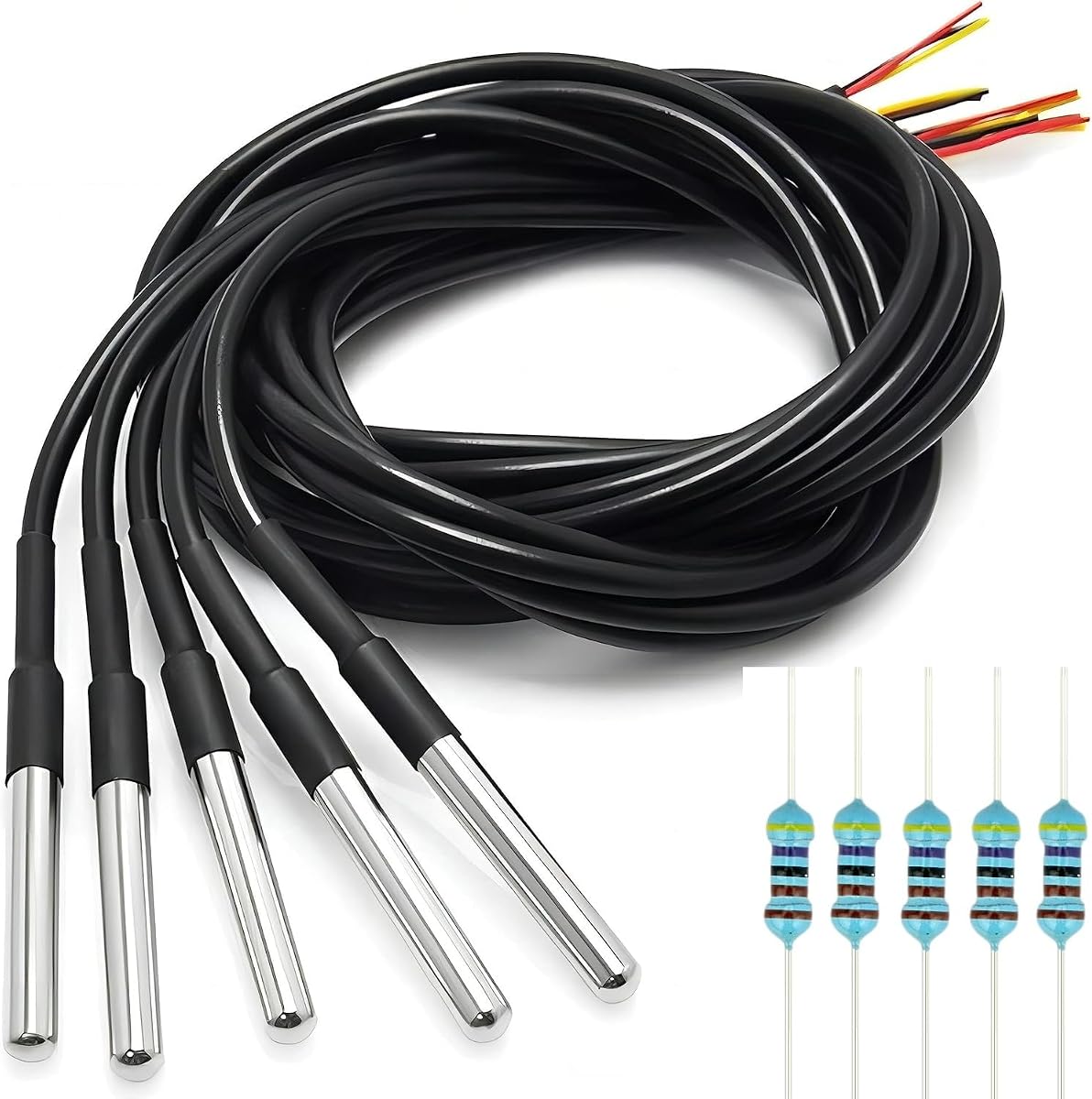
The WWZMDiB 5 Pcs pack delivers cost-effective waterproof monitoring. Rated 4.4 stars, it balances durability and affordability for multiple sensor deployments.
We may earn a commission when you buy through this link, at no additional cost to you.
Its waterproof design protects against moisture. Including five resistors ensures you can wire all units quickly without sourcing extra components separately.
While individual cable lengths vary, the value proposition remains strong. This kit supports large-scale monitoring networks where quantity matters for broad coverage.
Choose this for agricultural or industrial setups. You get multiple robust probes to track temperature across different zones or containers.
Each probe needs a pull-up resistor; getting five included saves you from buying additional parts for a multi-node setup.
The probes withstand wet conditions, making them suitable for outdoor use or submerged applications where moisture is common.
We may earn a commission when you buy through this link, at no additional cost to you.
The 2pcs DHT11 kit is perfect for quick experiments. Rated 4.3 stars, it offers basic temperature and humidity data for simple Arduino projects.
We may earn a commission when you buy through this link, at no additional cost to you.
Its compact design saves space on your breadboard. The included wires and low power consumption make it easy to integrate into portable prototypes.
Accuracy is basic with ±2°C and ±5% humidity. However, it is sufficient for general monitoring where exact precision is not critical for operation.
Use this for home hobby learning or school labs. The simplicity allows beginners to focus on coding logic rather than complex sensor calibration.
Its small footprint fits easily alongside other components without consuming excessive space on your project board.
The single-wire digital signal minimizes pin usage, leaving more I/O free for displays or buttons on your controller.
We may earn a commission when you buy through this link, at no additional cost to you.
The Gikfun 5PCS DS18B20 kit offers extended reach for distant sensors. Rated 4.5 stars, it supports monitoring in hard-to-access industrial locations.
We may earn a commission when you buy through this link, at no additional cost to you.
Its waterproof protection ensures durability in wet conditions. The 1-meter cable allows flexible placement inside tanks or behind machinery.
Note that an external resistor is needed for stability. Despite this extra step, the reliability makes it ideal for continuous temperature tracking.
Buy this for multi-point monitoring setups. The long cables let you route sensors precisely without stretching wires or risking connection failures.
The 100 cm length lets you place sensors deep inside containers where short leads would not reach effectively.
Sealed probes handle liquid exposure safely, ensuring longevity when submerged or used in high-humidity industrial environments.
We may earn a commission when you buy through this link, at no additional cost to you.
The HiLetgo DHT22 module improves upon older DHT11 versions. Rated 4.4 stars, it provides better precision for humidity and temperature data.
We may earn a commission when you buy through this link, at no additional cost to you.
Its ±0.5°C accuracy supports more reliable readings than cheaper alternatives. The AM2302 chip handles up to 100% humidity effectively.
While still less precise than industrial SHT sensors, it offers a solid middle ground. It is affordable yet robust enough for serious DIY environmental tracking.
Choose this for home automation or gardening. It balances cost with improved performance for projects needing consistent monitoring.
Measuring up to 100% RH ensures you can monitor wet environments without saturation errors.
The ±0.5°C accuracy provides reliable data for climate control systems where temperature stability matters.
We may earn a commission when you buy through this link, at no additional cost to you.
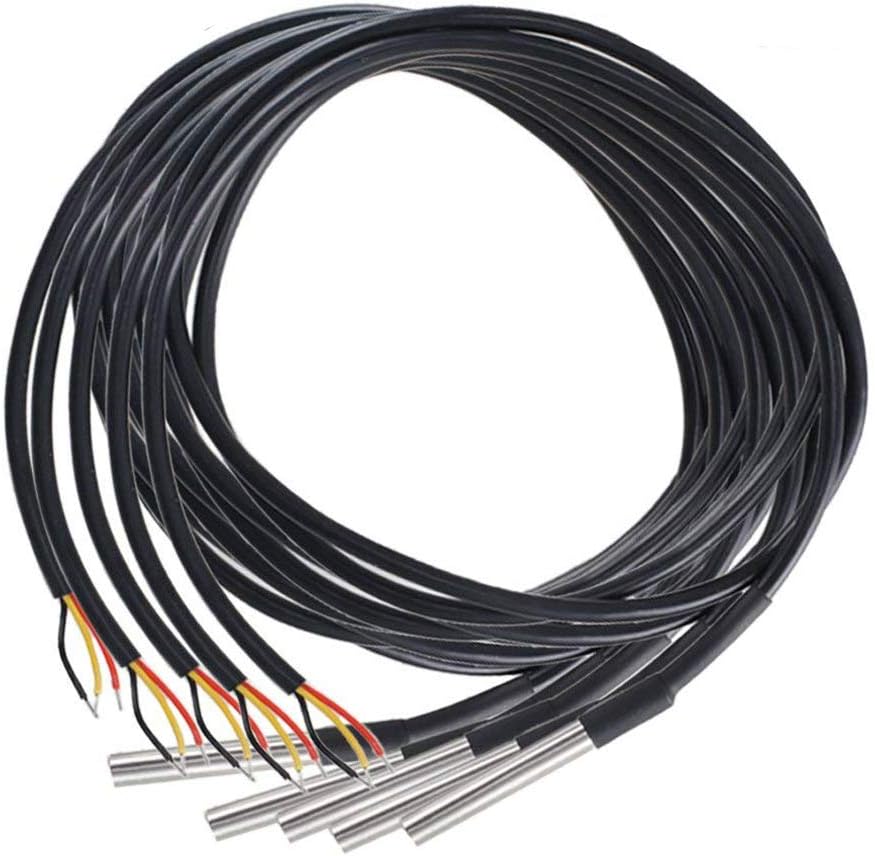
The HiLetgo DS18B20 stainless steel pack offers durability for harsh uses. Rated 4.5 stars, its robust housing ensures reliability in challenging environments.
We may earn a commission when you buy through this link, at no additional cost to you.
Its waterproof steel shell resists corrosion effectively. This makes it suitable for submersion in water or exposure to corrosive industrial gases.
Note that resistors must be sourced separately. However, the physical build quality justifies the extra effort for long-term deployment.
Buy this for industrial or outdoor weather stations. The steel casing ensures your sensors survive conditions that would damage standard plastic alternatives.
The stainless steel package protects internal electronics from rust and chemical degradation over time.
Sealed joints allow safe underwater use, making it ideal for monitoring tank levels or industrial fluid systems.
We may earn a commission when you buy through this link, at no additional cost to you.
Selecting the right sensor depends on your project needs, budget, and environment. This guide outlines key factors to consider before you buy.
Precision determines how close your readings are to actual values. Industrial projects need ±0.3°C accuracy, while hobbyists might tolerate ±2°C.
Check the datasheet for error margins before buying to avoid inaccurate data affecting your project outcomes.
Sensors use digital interfaces like I2C, single-wire, or analog outputs. I2C allows multiple sensors on few pins, while single-wire saves power.
Choose a protocol matching your microcontroller capabilities to simplify coding and wiring complexity.
Ensure the sensor supports your board's voltage like 3.3V or 5V. Operating outside this range may damage the component or cause unstable readings.
Look for wide voltage ranges to ensure compatibility with ESP32, Arduino Uno, or other platforms.
Verify the sensor covers the expected climate conditions for your use case. Some stop at 50°C, while others reach 125°C for industrial uses.
Select a sensor that exceeds your max expected temperature to ensure longevity and reliability in the field.
For outdoor or wet environments, choose waterproof probes with stainless steel housing. These prevent moisture from damaging internal electronics.
If your project stays dry, plastic modules may suffice and save money compared to rugged options.
Check if kits include resistors, wires, or adapter boards. Buying separately adds cost and complicates assembly for beginners.
Complete kits streamline setup and ensure you have all components needed to start measuring immediately.
Battery-powered projects require low-power sensors to extend run time. Some sensors stay active only during sampling, saving energy.
Prioritize low consumption models if your project runs on portable power sources without frequent recharging.
Cost varies by accuracy and features. Basic modules are cheap, but premium options offer better stability and longer life.
Balance your budget with reliability needs to avoid replacing components frequently due to failures or inaccuracies.
Connect the sensor power pins to your Arduino or ESP32. Ensure the voltage matches the sensor's requirements to prevent damage.
Use the correct library to read data. Most digital sensors require specific drivers to convert signals into readable temperature values.
Protect outdoor sensors from direct sunlight or condensation. Enclose them in ventilated cases to maintain accurate readings and ensure longevity.
The SHT31 and AHT30 models offer high precision with ±0.3°C accuracy. They are ideal for projects requiring reliable climate monitoring data.
Yes, waterproof DS18B20 probes work well outdoors. Ensure they are properly sealed to prevent moisture damage.
Digital protocols like I2C require pull-up resistors for stable communication. Check if your kit includes them before starting.
The DHT11 is popular for beginners due to simple wiring and libraries. It balances ease of use with reasonable accuracy.
Compare readings against a known accurate thermometer. Adjust software offsets if significant discrepancies appear in your environment.
Yes, I2C and 1-Wire support multiple devices on one bus. Assign unique addresses to prevent data conflicts.
We reviewed ten top Arduino temperature sensors highlighting accuracy, durability, and value. Whether you need budget options or precision industrial probes, there is a fit for your needs.
Prioritize accuracy and waterproofing based on your environment. Higher-end models offer better long-term stability for critical monitoring applications.
Prices and stock fluctuate daily so check availability before purchasing. Verify current specs on the product page to ensure compatibility with your project.